
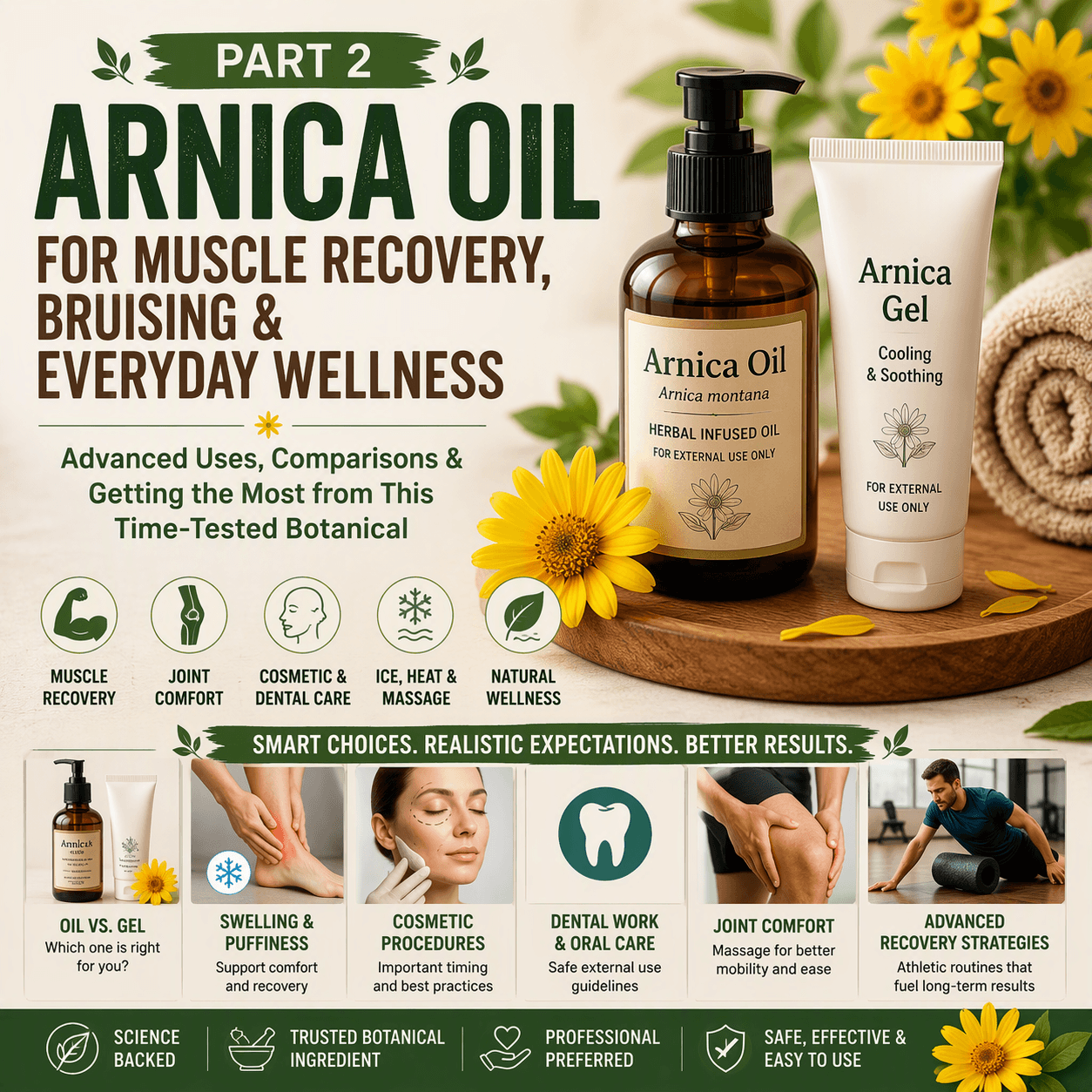
Advanced Uses, Comparisons & Getting the Most from This Time-Tested Botanical
By now, you know that arnica has earned its reputation as one of the most recognized ingredients in massage and recovery products. But choosing the right type of arnica, knowing when to use it, and understanding what it can—and can't—do are just as important as the ingredient itself.
Whether you're comparing arnica oil to a gel, recovering after a demanding workout, or wondering if arnica belongs in your skincare or recovery routine, this guide takes a practical look at how arnica fits into modern everyday wellness.
Arnica Recovery Guide at a Glance
Best Uses
Massage therapy
Post-workout recovery
Muscle tension and fatigue
Bruising support
Athletic recovery routines
Use With Extra Caution
Sensitive skin
Facial applications
Children
Pregnancy
Following medical or cosmetic procedures
Avoid Using On
X Open wounds
X Active infections
X Eyes
X Mouth
X Broken skin
What You'll Learn About Arnica Oil in This Section
- Arnica oil vs. arnica gel and when each makes sense
- Using arnica for swelling and puffiness
- Arnica after cosmetic procedures and dental work
- Whether arnica belongs in your facial skincare routine
- What to know about arnica for joint comfort
- Advanced recovery strategies for athletes and active lifestyles
- How arnica compares with witch hazel and other natural recovery ingredients
- Combining arnica with massage, ice, heat, and stretching for better results
Part 3 will focus on safety, storage, troubleshooting, myths, and a comprehensive FAQ covering the most common questions people ask online.
Which Arnica Product Is Right for You?
Many shoppers assume all arnica products work exactly the same way. In reality, formulation matters. The best product depends largely on how you intend to use it.
| Goal | Best Choice |
|---|---|
| Massage | Arnica Oil |
| Quick absorption | Arnica Gel |
| Sports massage | Arnica Oil |
| Before dressing | Arnica Gel |
| Large muscle groups | Arnica Oil |
| Portable daytime use | Arnica Gel |
| Skin nourishment | Arnica Oil |
| Cooling feel | Arnica Gel (if formulated that way) |
Rather than viewing the two formats as competitors, think of them as different tools designed for different situations.
Arnica Oil vs. Arnica Gel: Which One Is Better?
Choosing between arnica oil and arnica gel depends less on which product is "better" and more on how you plan to use it.
Oils excel during massage because they provide glide, working time, and skin conditioning. Gels absorb quickly and are often preferred when you don't want additional moisture on the skin.
In This Section You'll Discover
- The strengths of each format
- Which situations favor oil or gel
- Why many professionals keep both available
- How to choose based on your lifestyle
| Feature | Arnica Oil | Arnica Gel |
|---|---|---|
| Massage glide | Excellent | Limited |
| Absorption | Moderate | Fast |
| Large muscle groups | Excellent | Good |
| Professional massage | Excellent | Limited |
| Skin nourishment | High | Usually lower |
| Before dressing | Moderate | Excellent |
| Working time | Long | Short |
Choose Arnica Oil If You:
- Want to massage tired muscles
- Prefer a nourishing skin feel
- Need longer massage glide
- Enjoy recovery-focused self-care
- Are working on larger areas such as legs, shoulders, or back
Choose Arnica Gel If You:
- Want rapid absorption
- Prefer a lighter finish
- Need something before getting dressed
- Like cooling formulations
- Want a portable option for daytime use
Many people keep both products available, using oil for evening massage and recovery sessions while relying on gel during busy mornings.

Arnica Oil for Swelling and Puffiness
Swelling is one of the body's normal responses to physical stress, exercise, or minor injury.
While arnica is not a cure for inflammation, many people include it in wellness routines because massage and topical botanical care may help improve comfort while supporting the body's natural recovery process.
Common Causes of Temporary Swelling
- Intense exercise
- Minor bumps and impacts
- Repetitive movements
- Long travel days
- Cosmetic treatments
- Dental procedures
- Muscle overuse
Many people choose gentle massage with arnica once vigorous rubbing is appropriate and the skin remains healthy and intact.
Realistic Expectations For Arnica
Arnica should be viewed as part of a broader recovery plan rather than a stand-alone solution.
Helpful complementary habits include:
- Adequate hydration
- Proper nutrition
- Rest
- Gentle movement
- Appropriate stretching
- Massage
When Professional Care Is Appropriate
Seek medical evaluation if swelling:
- Is severe
- Continues worsening
- Occurs alongside fever
- Occurs with redness or heat
- Causes significant loss of function
- Follows a serious injury
How Long Does Arnica Take to Help Bruising?
One of the most common myths surrounding arnica is that it makes bruises disappear overnight. Unfortunately, no topical product can instantly erase a bruise.
Bruising follows the body's natural healing timeline.
Factors That Affect Bruise Recovery
- Bruise size
- Bruise location
- Age of the bruise
- Circulation
- Overall health
- Nutrition
- Sleep
- Consistency of care
Most uncomplicated bruises fade gradually over one to three weeks.
Some people notice improvements when using arnica consistently, while others observe little difference. Individual responses naturally vary.
Supporting Natural Healing
The following habits often play just as important a role as any topical product:
- Staying hydrated
- Eating nutrient-dense foods
- Resting adequately
- Maintaining gentle movement
- Following appropriate recovery practices

Arnica Oil After Cosmetic Procedures
Many people search for arnica following cosmetic treatments because bruising and swelling are common parts of recovery.
Timing, however, matters.
Applying products too early may interfere with healing or increase irritation.
People Commonly Ask About Arnica After:
- Dermal fillers
- Botox® injections
- Microneedling
- Laser treatments
- Eyelid procedures
- Facelifts
- Minor dermatological procedures
Every cosmetic procedure has a unique recovery timeline.
Always follow your provider's aftercare instructions before applying arnica—or any topical product.
Questions to Ask Your Provider Before Using Arnica
Before using arnica after a cosmetic procedure, consider asking:
- Has the skin healed enough for topical products?
- Is massage appropriate at this stage?
- Are there ingredients I should avoid?
- Is there a specific formulation you recommend?
- When can normal skincare products be resumed?
Professional medical advice should always take priority over general online recommendations.
Arnica After Dental Work and Oral Procedures
Facial swelling after dental procedures often prompts people to explore recovery options, including topical arnica.
While some individuals use arnica externally on intact skin around the jawline and cheeks, it should never be applied inside the mouth.
Important Guidelines
- External use only
- Avoid broken skin
- Never apply inside the mouth
- Follow your dentist's instructions
- Contact your dentist if swelling worsens unexpectedly
Because dental procedures vary tremendously, individualized guidance from your dental provider should always come first.
Can You Use Arnica Oil on Your Face?
Facial skin is thinner and often more sensitive than skin elsewhere on the body.
That means extra caution is appropriate when considering any massage oil for facial use.
While some people successfully use arnica on healthy facial skin, it generally works best when used sparingly and only after performing a patch test.
Facial Arnica Safety Checklist
Before using arnica on your face ensure:
✅ Skin is intact
✅ No irritation is present
✅ A patch test has been completed
✅ Eyes are avoided
✅ Lips are avoided
✅ Only a small amount is used
Stop Use If You Experience
- Redness
- Irritation
- Itching
- Burning
- Unusual sensitivity
Many products formulated specifically for facial skincare may be better suited to daily facial use than body oils designed primarily for massage.
Arnica Oil for Joint Comfort
Healthy joints depend on surrounding muscles, tendons, ligaments, and connective tissues working together efficiently.
While arnica does not repair damaged joints or treat arthritis, many people enjoy using arnica massage on muscles surrounding stiff or overworked joints.
Common Recovery Areas
- Knees
- Shoulders
- Elbows
- Wrists
- Ankles
- Hips
A Comprehensive Joint Wellness Approach
Joint comfort often improves most when massage is combined with:
- Gentle stretching
- Regular movement
- Appropriate exercise
- Healthy body weight
- Professional guidance when needed
Massage therapists frequently focus as much on surrounding muscles as the joint itself.
Arnica Oil for Athletic Recovery: Beyond the Basics
Recovery is where fitness improvements actually occur.
Training creates the stimulus. Recovery allows the adaptation.
That's why professional and recreational athletes alike devote significant attention to recovery habits.
A Complete Recovery Strategy Includes
- Nutrition
- Hydration
- Mobility work
- Massage
- Quality sleep
- Stress management
- Consistency
Arnica massage fits naturally into this larger recovery picture.
Example Recovery Routine
| Timeline | Activity |
|---|---|
| Immediately After Exercise | Cool down and hydrate |
| Within One Hour | Eat a balanced meal |
| Later That Day | Stretch and foam roll |
| Evening | Massage with arnica oil |
| Overnight | Prioritize quality sleep |
Successful athletes rarely rely on a single recovery tool.
Instead, they combine multiple evidence-based recovery habits consistently over time.

Arnica Oil vs. Witch Hazel
Both arnica and witch hazel are popular botanical ingredients, but they serve very different functions.
Understanding the distinction can help you select the right tool for your specific goal.
| Arnica Oil | Witch Hazel |
|---|---|
| Massage-friendly | Fast-drying |
| Longer skin contact | Quick evaporation |
| Nourishing feel | Often used as toner |
| Recovery-focused massage | Refreshing skin applications |
| Excellent glide | Minimal glide |
Choose Arnica When You Want:
- Massage
- Muscle recovery
- Longer skin contact
- Body oil applications
- Recovery-focused self-care
Choose Witch Hazel When You Want:
- Lightweight application
- Toning products
- Quick-drying formulas
- Minimal residue
- A refreshing finish
The two ingredients are often complementary rather than competing.
Combining Arnica with Other Recovery Methods
One of the best ways to think about arnica is as one tool within a larger recovery toolkit.
Pairing it with healthy lifestyle habits often creates a more balanced approach than relying on any single strategy.
Post Muscle Soreness Recovery Checklist
✔ Stay hydrated
✔ Eat enough protein
✔ Stretch regularly
✔ Prioritize quality sleep
✔ Massage tired muscles
✔ Return gradually to activity
✔ Stay consistent
Ice or Heat?
A common question is whether arnica should be paired with ice or heat.
A general approach is:
Ice
Often used soon after a minor injury when managing early swelling.
Heat
Often preferred later when addressing muscle tightness or stiffness.
Arnica Massage
Generally fits best once massage is appropriate and the skin remains intact.
Because every injury is different, severe injuries and persistent pain should always be evaluated by a qualified healthcare professional before beginning massage.
Coming Up in Part 3
Now that we've explored advanced uses, comparisons, and recovery strategies, Part 2B focuses on the practical questions people ask most often:
- Who should avoid arnica?
- Is arnica safe during pregnancy?
- Can children use arnica?
- Side effects and skin sensitivity
- Shelf life and storage
- Professional massage insights
- Troubleshooting disappointing results
- Myth vs. fact
- Extensive FAQ
By the end of Part 2, you'll have a complete understanding of how to use arnica safely, realistically, and effectively as part of a modern wellness routine.
See It Here: Best of Nature Therapeutic Arnica Sore Muscle Massage & Body Oil
Arnica Medical Disclaimer
This article is intended for educational and informational purposes only and should not be considered medical advice. Arnica products are not intended to diagnose, treat, cure, or prevent any disease. Always follow product instructions and consult a qualified healthcare professional regarding injuries, medical conditions, medications, pregnancy, or concerns about using herbal products. Do not apply arnica to broken skin, open wounds, or active infections.