
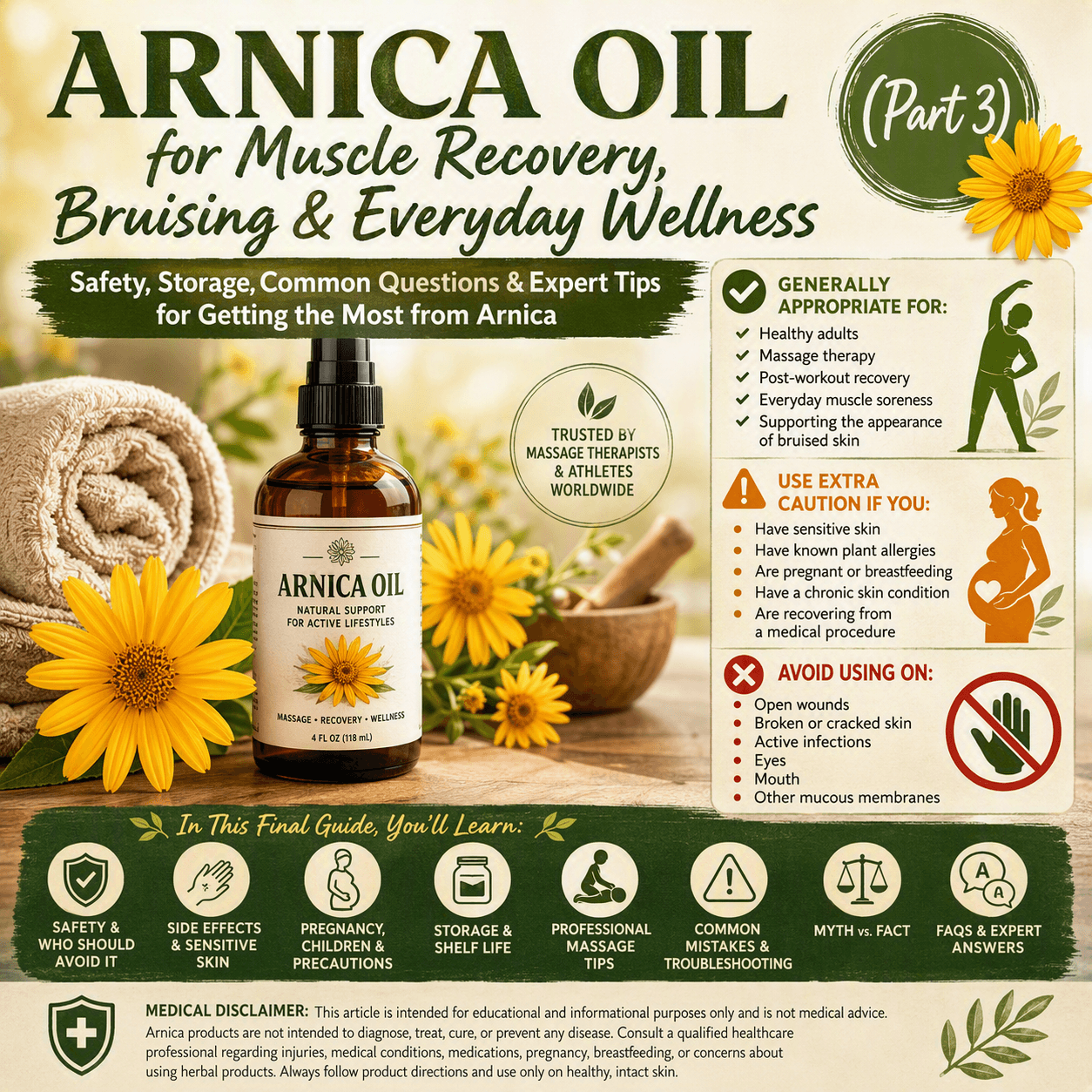
Safety, Storage, Common Questions & Expert Tips for Getting the Most from Arnica
Arnica has earned its place in massage therapy, sports recovery, and natural body care because it's versatile, easy to incorporate into a wellness routine, and trusted by professionals around the world. Like any topical product, however, using it correctly is just as important as choosing a quality formulation.
In this final installment of our complete guide, we'll answer the questions people ask most often—from who should avoid arnica and how to store it properly to the common mistakes that prevent people from getting the most from their recovery routine.
Arnica Safety Guide at a Glance
Generally Appropriate For:
✅ Healthy adults
✅ Massage therapy
✅ Post-workout recovery
✅ Everyday muscle soreness
✅ Supporting the appearance of bruised skin
Use Extra Caution If You:
⚠ Have sensitive skin
⚠ Have known plant allergies
⚠ Are pregnant or breastfeeding
⚠ Have a chronic skin condition
⚠ Are recovering from a medical procedure
Avoid Using On:
❌ Open wounds
❌ Broken or cracked skin
❌ Active infections
❌ Eyes
❌ Mouth
❌ Other mucous membranes

What You'll Learn About Arnica in This Section
We'll cover:
- Who should and shouldn't use arnica oil
- Possible side effects and how to minimize them
- Arnica and sensitive skin
- Pregnancy, children, and special precautions
- Storage and shelf life
- Professional massage tips
- Common mistakes and troubleshooting
- Myth vs. fact
- Frequently asked questions covering today's most searched topics
By the end of this guide, you'll have a practical understanding of how to use arnica responsibly, safely, and effectively as part of a complete wellness routine.
Who Should Not Use Arnica Oil?
Arnica oil is well tolerated by many people when used according to product directions on healthy, intact skin. However, there are situations where extra caution—or avoiding topical arnica altogether—is the better choice.
In This Section You'll Learn
- When arnica isn't appropriate
- Who should speak with a healthcare provider first
- Why intact skin matters
- How to reduce irritation risk
Do Not Apply Arnica To
- Open wounds
- Cuts or scrapes
- Burns
- Active skin infections
- Broken or cracked skin
- Eyes
- Mouth
- Other mucous membranes
Applying herbal products to damaged skin may increase irritation and may not be appropriate during wound healing.
Speak With Your Healthcare Provider First If You:
- Have a known allergy to arnica
- Have allergies to daisies, ragweed, marigolds, or chrysanthemums
- Have a chronic skin condition
- Are recovering from a medical procedure
- Are using prescription topical medications
- Are unsure whether arnica is appropriate for your situation
Most importantly, arnica should never replace professional evaluation for suspected fractures, severe injuries, rapidly worsening swelling, or persistent pain.
Can You Use Arnica Oil While Pregnant?
Pregnancy often brings new aches, muscle tension, and physical changes that encourage people to explore massage and natural body care products.
When it comes to arnica, a cautious approach is generally the most appropriate.
Before Using Arnica During Pregnancy
Consider:
- Speaking with your obstetrician or midwife
- Avoiding self-treatment of pregnancy-related swelling
- Choosing products specifically recommended by your provider
- Following all product directions carefully
Because research on topical arnica use during pregnancy remains limited, it's generally best not to add new products to your routine without professional guidance.
What About Breastfeeding?
The same conservative approach applies while breastfeeding.
Before introducing any new topical product, consult your healthcare provider to ensure it is appropriate for your individual circumstances.
Is Arnica Oil Safe for Children?
Children naturally collect bumps and bruises while learning, exploring, and playing.
This often leads parents to investigate topical products such as arnica.
While some arnica products are marketed toward families, not every product is suitable for every age group.
Keep These Guidelines For Using Arnica in Mind:
✅ Read the product label carefully
✅ Follow age recommendations
✅ Keep products away from eyes and mouth
✅ Supervise application
✅ Store products out of children's reach
If a child has:
- A significant injury
- Head trauma
- Deep bruising
- Severe swelling
- Persistent pain
Seek appropriate medical evaluation rather than relying solely on a topical product.
Can You Use Too Much Arnica Oil?
One of the most common misconceptions is that more product equals better results. In reality, applying excessive amounts of oil usually doesn't improve outcomes. It often leaves excess product sitting on the skin and may make massage less comfortable.
A Better Approach
- Start with a modest amount.
- Massage until absorbed.
- Add a little more if needed.
- Follow the frequency recommendations on the label.
Consistency generally matters more than quantity.
A small amount used regularly often provides a better overall experience than occasional heavy application.
Possible Side Effects and Skin Sensitivity
Like almost any botanical ingredient, arnica may not be suitable for everyone.
Fortunately, most potential issues can be minimized through proper use and patch testing.
Possible Reactions May Include
- Mild redness
- Itching
- Irritation
- Dryness
- Allergic contact dermatitis (rare)
Most people experience no issues when using appropriately formulated products on healthy skin.
First-Time User Patch Test
Before widespread use:
- Apply a small amount to the inside of your forearm.
- Wait 24 hours.
- Check for redness, itching, or irritation.
- Proceed only if the area remains comfortable.
Discontinue use if irritation develops.
Sensitive Skin and Plant Allergies
People with allergies to members of the Asteraceae (Daisy) family may be more likely to react to arnica.
This family includes:
- Ragweed
- Daisies
- Chrysanthemums
- Marigolds
- Sunflowers
If you've experienced reactions to these plants in the past, a patch test becomes especially important.
Sensitive Skin Checklist
Before full application:
✅ Patch test completed
✅ Skin is healthy and intact
✅ No active irritation present
✅ Product ingredients reviewed
✅ Only one new product introduced at a time
Following these precautions makes it easier to identify what works best for your skin.
Can Arnica Oil Be Mixed with Other Products?
One advantage of arnica oil is its versatility.
Many people successfully incorporate it into broader wellness and recovery routines.
Common Combinations With Arnica Include
- Unscented massage oils
- Carrier oils
- Moisturizing body oils
- Stretching routines
- Foam rolling sessions
- Heat therapy when appropriate
- Cold therapy when appropriate
A Simple Rule
Avoid introducing too many new active ingredients simultaneously.
When testing new products, use only one at a time so you can easily identify the source of any irritation or benefits.
Does Arnica Oil Expire?
Yes.
Like other botanical oils, arnica products gradually lose freshness over time. Exposure to oxygen, heat, and sunlight can affect an oil's aroma, appearance, texture, and performance.
To Maximize Shelf Life
✔ Store in a cool location
✔ Keep the bottle tightly closed
✔ Avoid direct sunlight
✔ Minimize heat exposure
✔ Use clean hands when dispensing
✔ Follow manufacturer expiration dates
Signs It May Be Time to Replace Your Arnica Oil
- Unusual odor
- Significant color changes
- Unexpected separation
- Altered texture
- Expired best-by date

Why Massage Therapists Frequently Choose Arnica
Professional massage therapists evaluate products differently than most consumers.
They're not simply looking for an ingredient list—they're evaluating how a product performs throughout an entire treatment session.
Professionals Often Value
- Smooth glide
- Balanced absorption
- Comfortable skin feel
- Easy cleanup
- Consistent quality
- Reliable working time
- High-quality carrier oils
Because massage sessions can last 30, 60, or even 90 minutes, professionals often prefer products that deliver consistent performance without requiring constant reapplication.
Many therapists also appreciate formulations that leave skin feeling soft rather than greasy.
Common Reasons Arnica Doesn't Meet Expectations
When people claim arnica "didn't work," the issue is often expectations rather than the product itself.
Common Mistakes With Arnica Include:
- Expecting instant results
- Applying inconsistently
- Using it on severe injuries
- Choosing low-quality formulations
- Skipping massage altogether
- Expecting bruises to disappear overnight
It's also important to remember that recovery differs from person to person.
Factors that influence recovery include:
- Age
- Circulation
- Hydration
- Nutrition
- Sleep quality
- Activity level
- Overall health
No topical product can override all of these factors.
Arnica Myths vs. Facts
Separating fact from fiction helps set realistic expectations.
| Myth | Fact |
|---|---|
| Arnica heals broken bones. | Arnica does not repair fractures. Suspected fractures require medical evaluation. |
| More arnica works faster. | Excessive amounts do not necessarily improve results. |
| Arnica replaces medical treatment. | Arnica may complement a wellness routine but should not replace appropriate medical care. |
| All arnica products are identical. | Formulations, concentrations, and intended uses vary considerably. |
| Arnica works instantly. | Recovery takes time and varies between individuals. |
| Arnica oil and homeopathic arnica are the same thing. | They are different products produced using different methods. |

Frequently Asked Questions (FAQs)
What Is Arnica Oil Best Used For?
Arnica oil is most commonly used for:
- Massage therapy
- Muscle recovery
- Post-workout routines
- Everyday muscle fatigue
- Supporting the appearance of bruised skin
Its popularity stems from the combination of a massage-friendly carrier oil and a traditional botanical ingredient.
How Often Should You Apply Arnica Oil?
Always follow the instructions on your specific product.
Many people use arnica:
- After workouts
- During massage
- Before bedtime
- As part of an evening recovery routine
More frequent application isn't necessarily better.
Can Arnica Oil Reduce Swelling?
Many people incorporate arnica into routines designed to support recovery from minor swelling associated with everyday activity or bruising.
However, significant swelling, worsening pain, or swelling following serious injury requires professional evaluation.
Is Arnica Oil Good for Sore Muscles?
Yes.
This is one of the most common reasons people use it.
Massage with arnica oil is frequently included in recovery routines following:
- Strength training
- Running
- Cycling
- Physical labor
- Sports participation
Can You Use Arnica Oil for Joint Discomfort?
Many people massage arnica into muscles surrounding:
- Knees
- Shoulders
- Hips
- Ankles
- Elbows
- Wrists
While arnica doesn't repair joints or treat arthritis, massage may help encourage relaxation and comfort.
Is Arnica Oil Safe for Sensitive Skin?
Many people with sensitive skin use arnica successfully.
However:
✅ Perform a patch test first
✅ Start with a small amount
✅ Stop using if irritation develops
Can You Use Arnica Oil Under Makeup?
Most massage oils are richer than traditional facial skincare products.
For that reason, they're generally not ideal beneath makeup.
If facial use is appropriate:
- Use only a small amount
- Allow complete absorption
- Avoid eyes and lips
Can You Ingest Arnica Oil?
No.
Arnica massage oils are intended for external use only unless specifically formulated and labeled otherwise.
Never ingest massage oil.
Is Natural Arnica Better Than Synthetic Alternatives?
Many consumers prefer botanical arnica because of its long history in traditional wellness practices.
However, formulation quality matters just as much as the botanical source itself.
Carrier oils, manufacturing standards, and overall product design all contribute to the user experience.
How Long Does a Bottle Usually Last?
That depends on usage.
A bottle used occasionally for self-massage may last several months.
A massage therapist performing multiple sessions per day may use a bottle much more quickly.
Can Arnica Replace Stretching, Hydration, or Proper Recovery?
No.
Arnica works best as one component of a complete recovery strategy that includes:
- Movement
- Hydration
- Nutrition
- Sleep
- Appropriate training
- Consistent recovery habits
Final Thoughts About Using Arnica Oil
Arnica has earned its place among the world's most respected botanical ingredients not because it's a miracle cure, but because it consistently fits well within balanced wellness and recovery routines.
From professional massage practices and athletic recovery programs to simple self-care routines at home, arnica continues to be valued for its versatility, ease of use, and long history of traditional use.
Whether you're massaging tired muscles after exercise, supporting the appearance of everyday bruises, or simply making relaxation a priority, choosing a high-quality arnica oil and using it consistently can help make recovery a more intentional—and enjoyable—part of your overall wellness routine.
Medical Disclaimer
This article is intended for educational and informational purposes only and is not medical advice. Arnica products are not intended to diagnose, treat, cure, or prevent any disease. Consult a qualified healthcare professional regarding injuries, medical conditions, medications, pregnancy, breastfeeding, or concerns about using herbal products. Always follow product directions and use only on healthy, intact skin.