
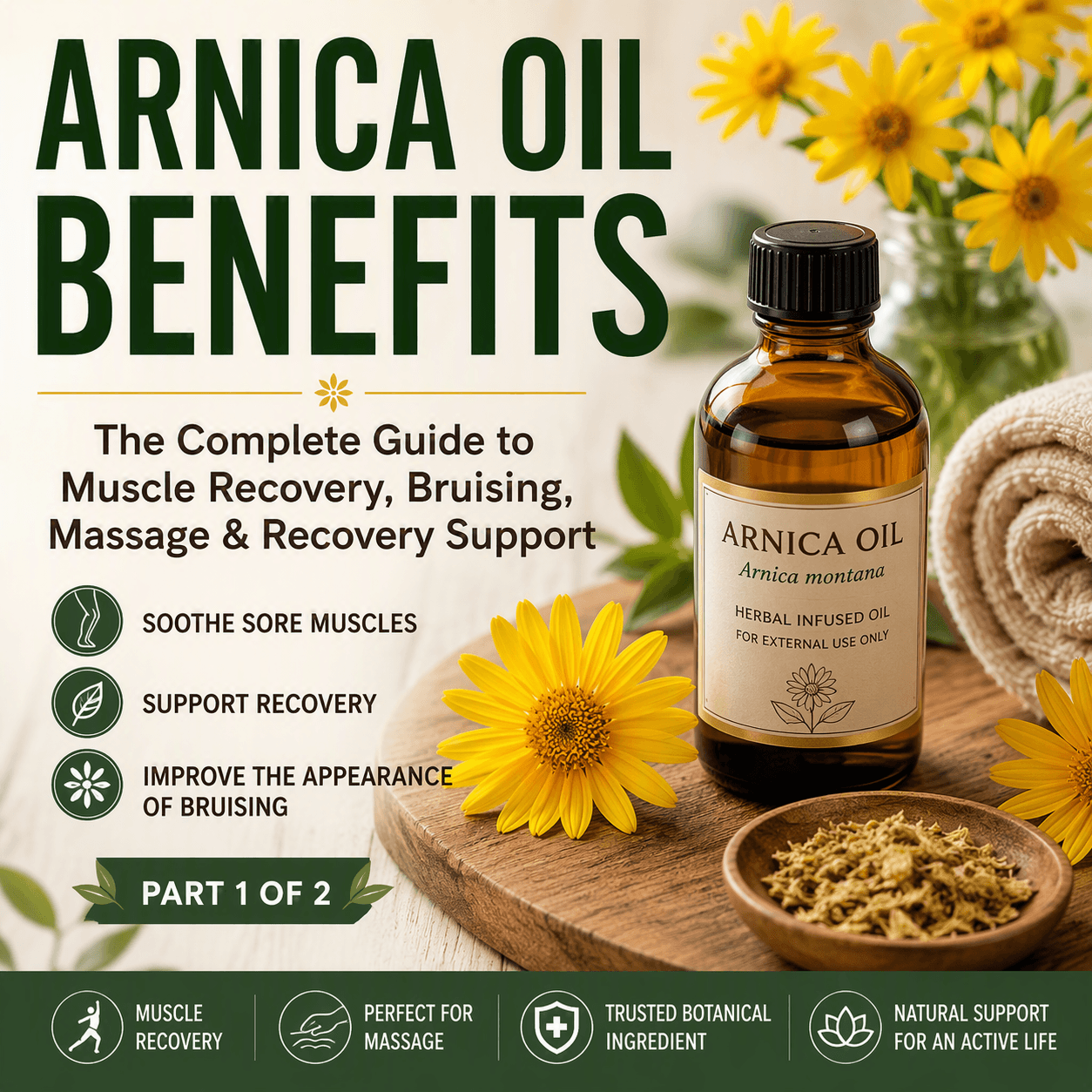
Arnica oil has been a trusted staple in massage therapy, sports recovery, and herbal wellness for generations. From professional massage therapists to runners, cyclists, and everyday wellness enthusiasts, people continue to turn to arnica oil to support muscle recovery, soothe overworked tissues, and improve the appearance of bruising.
But despite its popularity, many people still have questions.
Does arnica actually work? How does it compare to other natural recovery ingredients? Is it safe? What's the best way to use it?
This guide answers those questions while exploring the science, history, and practical uses of arnica oil so you can decide whether it deserves a place in your wellness routine.

Arnica Oil at a Glance
Before diving deeper, here's a quick overview of what arnica oil is—and what it isn't.
Best For
- Massage therapy
- Post-workout recovery
- Temporary muscle fatigue
- Everyday stiffness
- Supporting the appearance of bruised skin
Not Intended For
- Open wounds
- Broken skin
- Serious injuries
- Medical emergencies
- Replacing professional medical care
Primary Form
Arnica oil is typically an herbal-infused carrier oil made from Arnica montana flowers rather than a steam-distilled essential oil.
How It's Used
- Applied topically to intact skin
- Used during professional massage sessions
- Incorporated into post-exercise recovery routines
- Included in self-care and wellness practices
Important Note
Arnica products are intended for external use only. Always follow product directions and discontinue use if irritation occurs.
What You'll Learn in Part 1
In this guide we'll cover:
- What arnica oil is and how it's made
- Why arnica has remained popular for centuries
- The natural compounds that make arnica unique
- What current research says about its effectiveness
- How massage therapists use arnica oil
- Arnica for sore muscles, bruises, and workout recovery
- Step-by-step instructions for using arnica correctly
- Common mistakes that can limit results
Part 2 will focus on safety, comparisons, special situations, troubleshooting, and answer dozens of frequently asked questions people search for online.
What Is Arnica Oil? Benefits, Uses, and How It Works
Arnica oil is a botanical infusion created by steeping Arnica montana flowers in a nourishing carrier oil. The finished oil is widely used in massage therapy and body care because it combines excellent massage glide with plant compounds that have long been associated with soothing tired muscles, supporting recovery, and caring for skin after everyday bumps and bruises.
In This Section You'll Discover
- Where arnica comes from
- How arnica oil is produced
- Why it's different from an essential oil
- Where it's commonly used
- Why it has become a massage favorite
Arnica grows naturally in the mountain meadows of Europe, where it has been harvested and used in herbal preparations for centuries. Modern topical arnica products are commonly derived from Arnica montana, the species most frequently associated with commercial wellness products.
Unlike essential oils, which are typically produced through steam distillation, arnica oil is generally an infused botanical oil. During production, dried arnica flowers are steeped in a carrier oil, allowing naturally occurring plant compounds to migrate into the finished blend.
The result is a massage-friendly oil designed for external use only.
Today, arnica is commonly found in:
| Product Type | Typical Purpose |
|---|---|
| Massage oils | Recovery and relaxation |
| Body oils | Daily wellness |
| Sports massage blends | Post-exercise support |
| Bruise-care products | Appearance support |
| Muscle balms | Localized comfort |
| Recovery creams | Active lifestyles |
| Spa treatments | Full-body massage |
Its versatility is one reason arnica remains one of the most recognizable botanical ingredients in professional massage and recovery products.
Why Arnica Has Stood the Test of Time
Few herbal ingredients have maintained their popularity as consistently as arnica.
Many wellness trends rise and fall, but arnica has remained relevant because it fits naturally into recovery routines and complements hands-on bodywork.
This Section Explains
- Why arnica has survived for centuries
- Who commonly uses it today
- Why professionals continue to reach for it
- How traditional use compares with modern wellness
Over time, arnica transitioned from traditional European herbal practices into modern sports recovery programs, spa treatments, rehabilitation settings, and professional massage environments.
Today, it's commonly used by:
- Massage therapists
- Physical therapists
- Chiropractors
- Athletic trainers
- Personal trainers
- Runners
- Cyclists
- Golfers
- Weekend warriors
- Individuals managing everyday muscle fatigue
Part of arnica's enduring appeal is that it works alongside healthy recovery habits rather than attempting to replace them.
Stretching, hydration, movement, massage, nutrition, and quality sleep all contribute to recovery. Arnica often serves as a complementary addition to that broader wellness strategy.
The Science Behind Arnica: What Makes It Different?
Arnica contains a diverse collection of naturally occurring plant compounds that have attracted scientific interest for decades.
Researchers continue studying how these compounds interact with biological processes involved in inflammation, recovery, and tissue response.
Here's What We'll Explore
- The key compounds found in arnica
- Why researchers study helenalin
- The role of antioxidants and flavonoids
- What scientists know—and what they're still learning
Among arnica's naturally occurring constituents are:
- Sesquiterpene lactones
- Helenalin
- Flavonoids
- Phenolic compounds
- Essential oil components
- Plant antioxidants
Helenalin has received particular scientific attention because laboratory research suggests it may influence certain inflammatory pathways. Researchers continue investigating exactly how these mechanisms translate into real-world topical use.
It's also important to understand that no botanical ingredient is a cure-all. Results can vary based on formulation quality, concentration, individual biology, application technique, and consistency of use.

Does Arnica Oil Really Work for Bruising, Sore Muscles, and Recovery?
The honest answer is that arnica isn't magic—but it also isn't simply marketing hype.
Research on topical arnica has produced mixed findings. Some studies suggest benefits for bruising, soreness, and certain forms of swelling, while others report outcomes comparable to placebo. Researchers attribute these differences to variations in formulations, concentrations, treatment timing, and study design.
Despite the mixed evidence, arnica remains one of the most widely used botanical ingredients in massage and sports-recovery products. Many users and practitioners continue reporting positive experiences, particularly when arnica massage is combined with other healthy recovery habits.
What Studies Generally Suggest
| Area | Current Evidence |
|---|---|
| Bruising | Some studies suggest modest improvement in appearance and recovery time |
| Muscle soreness | Evidence remains mixed |
| Post-procedure swelling | Some encouraging findings |
| Recovery after exercise | May offer supportive benefits as part of a recovery routine |
| Chronic pain conditions | Evidence remains inconclusive |
Researchers continue investigating topical arnica, and current evidence does not support sweeping claims about guaranteed results.
What Arnica Has Not Been Proven to Do
Arnica has not been proven to:
- Instantly eliminate bruises
- Cure injuries
- Replace medical treatment
- Prevent muscle soreness entirely
- Heal torn muscles
- Produce identical results for every individual
- Accelerate recovery in every situation
Realistic expectations are essential. Arnica is best viewed as one supportive component within a broader recovery strategy that includes movement, hydration, nutrition, massage, and rest.
Why Massage Therapists Love Arnica Oil
Massage therapists evaluate products based on performance, feel, absorption, working time, and overall client experience.
Arnica has become a favorite because it checks many of those boxes.
We'll Cover
- Professional massage benefits
- Texture and glide
- Skin feel
- Recovery applications
- Why formulation matters
A quality arnica massage oil should provide:
- Smooth glide without excessive drag
- Sufficient working time
- Comfortable absorption
- A non-sticky finish
- Skin-conditioning carrier oils
- Easy cleanup
Because massage naturally supports circulation, mobility, relaxation, and recovery, many therapists appreciate incorporating botanical ingredients such as arnica into sessions focused on muscle fatigue and post-exercise recovery.
The massage itself remains the primary therapeutic component. Arnica simply complements the experience.
Arnica Oil Benefits for Sore Muscles, Stiffness, and Everyday Recovery
You don't need to be a competitive athlete to appreciate arnica.
Everyday activities—from gardening and travel to long hours at a desk—can leave muscles feeling tight and overworked.
Common Reasons People Use Arnica
- Weight training
- Running
- Cycling
- Gardening
- Home improvement projects
- Long workdays
- Poor posture
- Weekend sports
- Travel-related stiffness
Large muscle groups that commonly receive massage include:
- Neck
- Shoulders
- Upper back
- Lower back
- Quadriceps
- Hamstrings
- Calves
- Forearms
Regular massage may help reduce feelings of tightness, encourage relaxation, and support comfortable movement after physical activity.
Arnica Oil for Workout Recovery
Recovery begins immediately after exercise.
While no single product determines recovery, combining multiple healthy habits often produces the best results.
An Effective Recovery Sequence
- Cool down gradually.
- Rehydrate.
- Eat a balanced meal or snack.
- Stretch gently.
- Massage tired muscles with arnica oil.
- Prioritize quality sleep.
Athletes frequently use arnica after:
- Marathon training
- Strength training
- Team sports
- Hiking
- Swimming
- Cycling
- Tennis
- Pickleball
- High-intensity workouts
Small recovery habits performed consistently often have a greater cumulative impact than occasional intensive recovery efforts.

Arnica Oil for Bruises: What Should You Expect?
Bruises are a normal part of life.
Whether caused by sports, daily activities, or minor accidents, most people simply want them to fade as quickly as possible.
Arnica has become one of the most commonly used botanical ingredients for supporting the appearance of bruised skin.
In This Section You'll Learn
- Why bruises change color
- When arnica is commonly applied
- What realistic timelines look like
- When not to use arnica
A bruise develops when small blood vessels beneath the skin break and blood becomes trapped under the surface.
As the body gradually clears this blood, bruises change color.
| Healing Stage | Typical Color |
|---|---|
| Early | Red or Purple |
| Developing | Blue or Deep Purple |
| Mid-Healing | Green |
| Final Healing | Yellow or Brown |
Many people begin applying topical arnica soon after bruising appears, provided the skin remains intact.
While arnica may support the appearance of bruised skin, most bruises naturally fade over one to three weeks depending on severity, age, location, and individual healing responses.
How to Apply Arnica Oil Correctly
Using arnica is simple, but proper application can improve both safety and effectiveness.
Follow These Five Steps
- Wash and dry the area.
- Dispense a small amount of oil into your hands.
- Massage gently using slow circular motions.
- Allow the oil to absorb naturally.
- Reapply according to product directions if desired.
Avoid applying arnica to:
- Open wounds
- Broken skin
- Active infections
- Eyes
- Mouth
- Other mucous membranes
If symptoms worsen or persist, seek advice from a qualified healthcare professional.
Patch Testing and Plant Allergies
Although topical arnica is well tolerated by many people, some individuals may experience sensitivity.
People with allergies to members of the Asteraceae (daisy) family may wish to perform a patch test before widespread use. This plant family includes ragweed, daisies, marigolds, chrysanthemums, and sunflowers.
How to Perform a Patch Test
- Apply a small amount to a small area of skin.
- Wait 24 hours.
- Monitor for redness, itching, irritation, or discomfort.
- Discontinue use if irritation develops.
Contact dermatitis and skin irritation have been reported in some individuals using topical arnica preparations.
Common Mistakes That Prevent Good Results
Many disappointments arise from unrealistic expectations or improper application techniques.
Watch Out for These Common Mistakes
- Expecting immediate results
- Applying excessive amounts
- Using arnica on broken skin
- Skipping a patch test despite known sensitivities
- Massaging fresh bruises too aggressively
- Assuming arnica replaces medical care
- Using products inconsistently
Patience and consistency usually produce better outcomes than overuse.
Coming Up in Part 2
Now that you understand what arnica is, how it's made, and why it has become one of the most respected botanicals in massage therapy, it's time to explore the practical side of using it.
In Part 2, we'll answer many of the questions people ask most often, including:
- Is arnica oil or arnica gel better?
- Can you safely use arnica on your face?
- Does arnica help swelling after cosmetic procedures?
- Can it be used during pregnancy?
- Is it appropriate for children?
- How does it compare with witch hazel?
- Can it be combined with ice or heat therapy?
- How should it be stored?
- What are the possible side effects?
Plus, we'll cover dozens of real-world questions from athletes, massage therapists, wellness enthusiasts, and shoppers looking to get the most from topical arnica products.
By the end of this two-part guide, you'll have a clear understanding of where arnica fits within a modern recovery routine, how to use it confidently, and what realistic results you can expect from this time-honored botanical.

See It Here: Best of Nature Therapeutic Arnica Sore Muscle Massage & Body Oil
Medical Disclaimer
This article is intended for educational and informational purposes only and should not be considered medical advice. Arnica products are not intended to diagnose, treat, cure, or prevent any disease. Always follow product instructions and consult a qualified healthcare professional regarding injuries, medical conditions, medications, pregnancy, or concerns about using herbal products. Do not apply arnica to broken skin, open wounds, or active infections.