
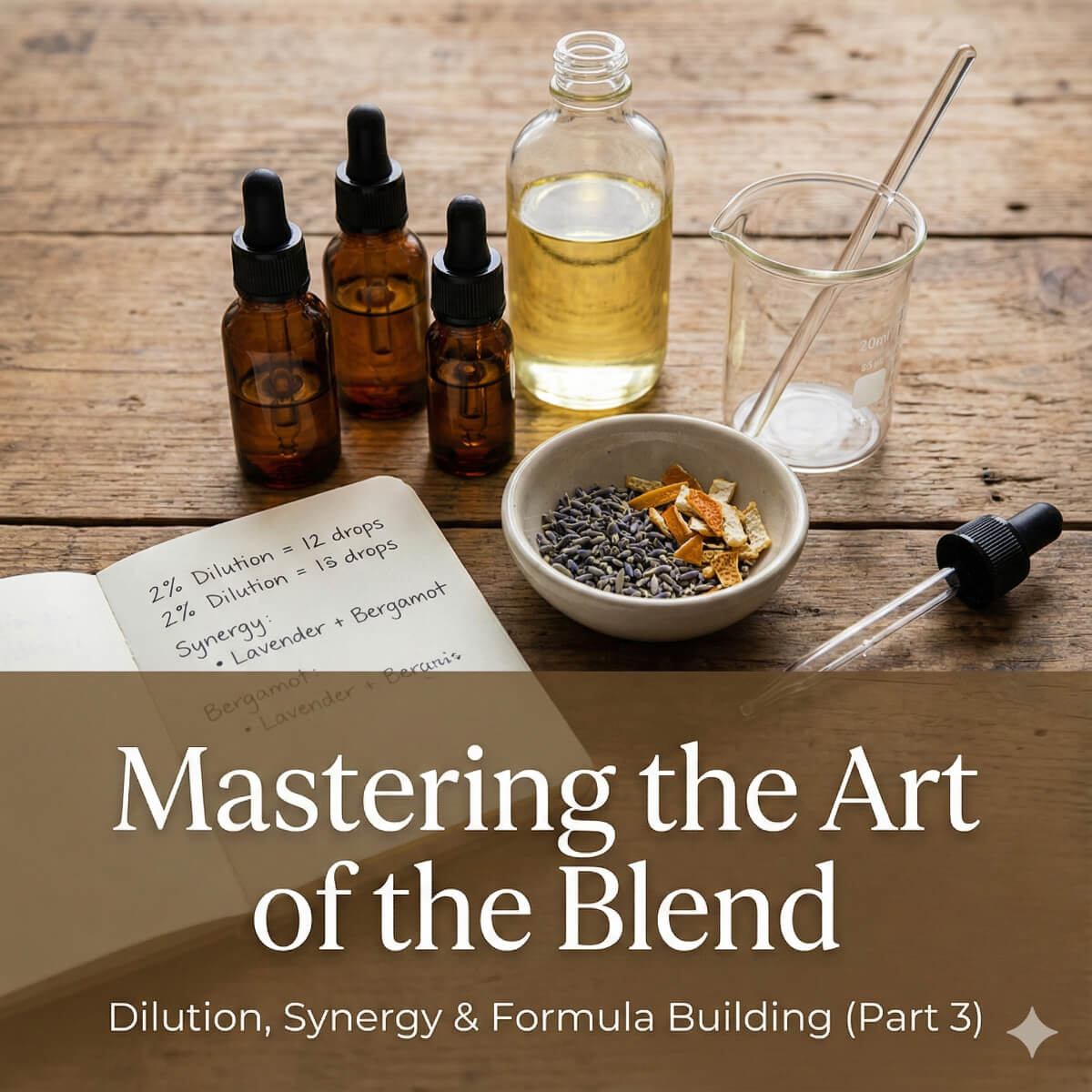
Welcome back to our aromatherapy masterclass!
In Part 1, we explored Carrier Oils and Why They’re Essential. In Part 2, we started Exploring Popular Carrier Oils & Their Benefits. Now, in Part 3, we are bringing it all together to understand how to create aromatherapy oils using the carriers.
This is where the science of safety meets the art of blending.
Whether you are looking to craft a signature scent, a potent muscle rub, or a nightly sleep serum, knowing how to dilute properly and blend for "synergy" is the key to getting real results. Let’s turn you from an enthusiast into a skilled formulator.

1. The Golden Rule: Why Dilution Matters
It can be tempting to use essential oils "neat" (undiluted) to get a stronger smell, but in aromatherapy, less is often more.
Essential oils are highly concentrated plant extracts. Diluting them with a carrier oil (like the Jojoba or Almond oil we discussed last week) is non-negotiable for three reasons:
-
Safety: It prevents skin irritation, sensitization, and chemical burns.
-
Absorption: Carrier oils help the volatile essential oils absorb into the skin rather than evaporating into the air.
-
Economy: Dilution extends the life of your precious oils without sacrificing therapeutic value.
See our 100% Pure Essential Oils
2. The Ultimate Dilution Guide
How many drops should you actually use? Save this chart! It is the industry standard for safe, effective blending.
General Dilution Guidelines
Making a standard rollerball or dropper bottle? Use this cheat sheet:
-
0.5% (Subtle): 3–4 drops total
-
1% (Light): 6–9 drops total
-
2% (Standard): 12–18 drops total
-
3% (Strong): 20–27 drops total
-
5% (Very Strong): 30–45 drops total

3. Understanding Synergy: The "Secret Sauce"
Have you ever mixed two oils and found the result smelled terrible? Or mixed two others and found the effect was incredibly powerful? That is the concept of Synergy.
A synergy is a blend where the oils reinforce each other, creating a result that is greater than the sum of its parts (1 + 1 = 3).
-
Mood Support: Oils like Lavender and Bergamot soften each other to create deep relaxation.
-
Pain Relief: Warming oils like Ginger and Black Pepper work together to increase circulation better than they would alone.
4. How to Build a Balanced Formula
Ready to be your own alchemist? Follow this 3-step framework used by professional aromatherapists.
Step A: The "Perfume" Method (Top, Middle, Base)
To make a blend that smells amazing and lasts, try to include oils from different "notes."
-
Top Notes (30%): Fresh and fast-acting (e.g., Lemon, Peppermint, Eucalyptus).
-
Middle Notes (50%): The "heart" of the blend (e.g., Lavender, Rosemary, Geranium).
-
Base Notes (20%): Grounding and long-lasting (e.g., Patchouli, Cedarwood, Vetiver).
Step B: Define Your Purpose
Don't just grab random bottles. Ask yourself: What is this for?
-
Is it for sleep? Reach for Roman Chamomile and Vetiver.
-
Is it for sore muscles? Reach for Marjoram and Rosemary.
Step C: The Creation Process
-
Select 2–4 oils that match your goal.
-
Determine your dilution (e.g., 2% for a body oil).
-
Blend & Test: Mix a small amount first. Let it "rest" for 24 hours so the scents can marry.
-
Document it: Always write down your recipe!
5. Try These 3 Ready-to-Use Formulas
Grab your empty bottles and let’s get blending.
1. "Calm the Chaos" Stress Relief Blend
A balanced, soothing aroma perfect for massage or a daily body oil.
-
Dilution: 2% (Standard)
-
Base: 1 oz (30mL) Sweet Almond Oil [Link to Product]
-
The Blend:
-
6 drops Lavender (Soothing middle note)
-
4 drops Bergamot (Uplifting top note)
-
2 drops Frankincense (Grounding base note)
-
2. "Deep Relief" Muscle Ease
A warming, potent blend for post-workout soreness or tight shoulders.
-
Dilution: 3% (Therapeutic Strength)
-
Base: 1 oz (30mL) Fractionated Coconut Oil [Link to Product]
-
The Blend:
-
5 drops Sweet Marjoram
-
4 drops Ginger
-
4 drops Rosemary
-
3. "Drift Away" Sleep Serum
A heavy, relaxing blend to help you switch off at night.
-
Dilution: 1% (Gentle)
-
Base: 1 oz (30mL) Jojoba Oil [Link to Product]
-
The Blend:
-
4 drops Roman Chamomile
-
3 drops Vetiver
-
2 drops Lavender
-

Your Aromatherapy Library is Complete!
Congratulations! Over this three-part series, you’ve learned the properties of essential oils, how to choose the right carrier oil, and now, how to blend them safely and effectively.
You now possess the knowledge to build a natural medicine cabinet tailored specifically to your needs.
See our entire library of Aromatherapy Supplies
Frequently Asked Questions: Blending & Diluting
Q: Can I mix any essential oils together? A: Technically, yes, you can mix any oils, but not all combinations will smell good or have a therapeutic benefit. We recommend sticking to the "Synergy" guidelines above (mixing oils with similar properties) or using the Top/Middle/Base note method to ensure your blend is balanced and effective.
Q: How long do my DIY aromatherapy blends last? A: This depends on the carrier oil you use. A blend made with Jojoba Oil or Fractionated Coconut Oil can last 2–3 years if stored correctly. Blends made with Sweet Almond or Rosehip Oil have a shorter shelf life (typically 6–12 months). Always store your blends in dark glass bottles in a cool, dark place to extend their life.
Q: Can I use water instead of a carrier oil? A: No. Essential oils are hydrophobic, meaning they do not mix with water. If you drop essential oils into water (like a bath) without a dispersant, the oil will sit on top of the water and can stick to your skin in its undiluted, potent form, potentially causing irritation. Always dilute with a carrier oil or use a solubilizer before adding to water.
Q: What happens if I accidentally use too much essential oil? A: If you apply a blend and it stings, burns, or turns red, do not try to wash it off with water. Water will drive the oil deeper into the skin. Instead, immediately apply more carrier oil (or any vegetable oil you have, like olive oil) to the area to dilute the essential oil further and wipe it away with a soft cloth.
Q: Can I use these blends on my pets? A: Animals metabolize oils differently than humans. Some essential oils that are safe for us (like Tea Tree, Peppermint, and Citrus oils) can be toxic to cats and dogs. Always consult with a veterinarian or use resources specifically designed for animal aromatherapy before using any blends on or around your pets.
Q: Do I need to count drops exactly? A: While you don't need to be in a laboratory environment, being precise is important for safety. Using a plastic pipette or a dropper bottle helps ensure you stick to the safe dilution percentages. If you accidentally add one extra drop to a 1 oz bottle, it’s likely fine, but consistently overdosing can lead to sensitization over time.