
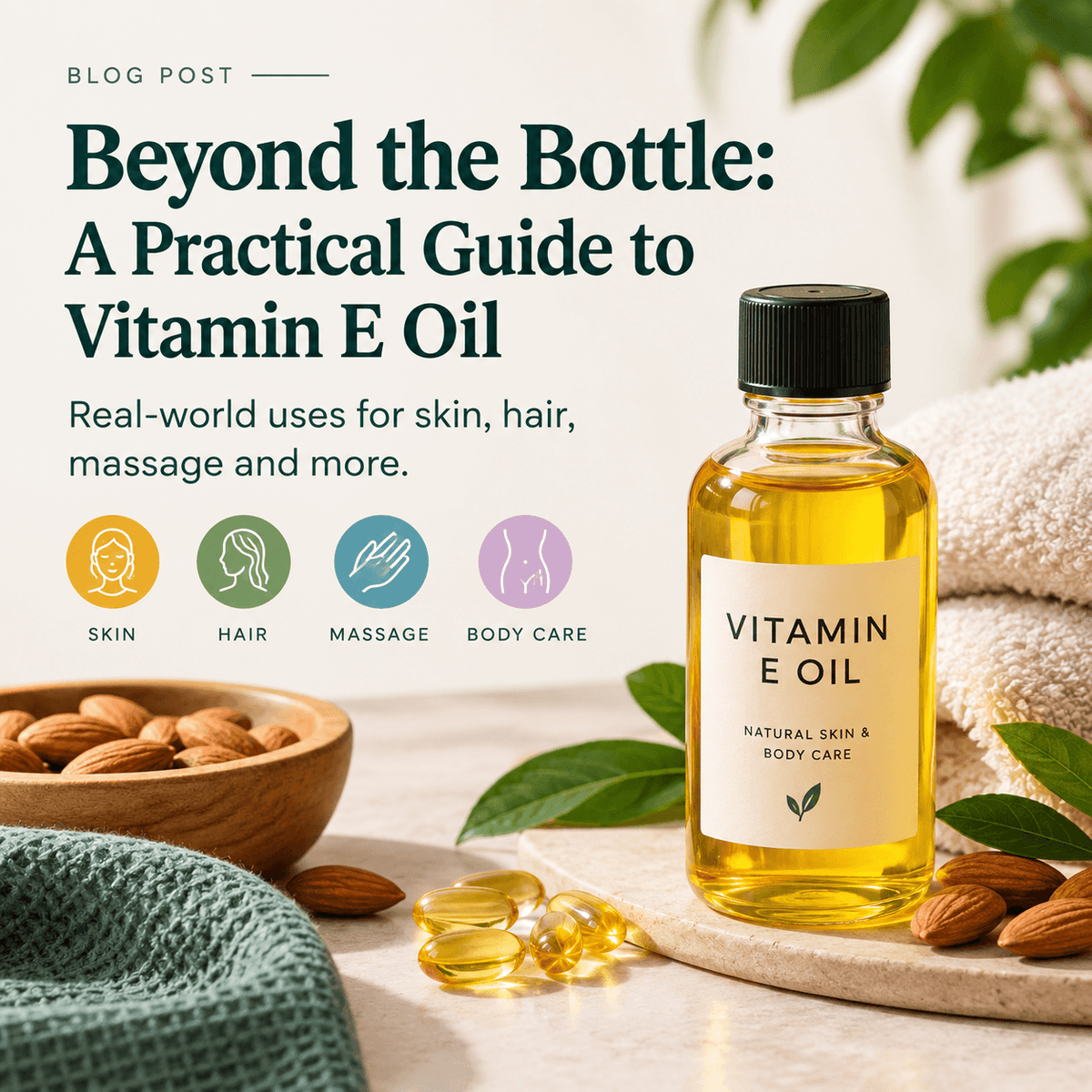
Vitamin E oil has a place in many skincare routines, but knowing what it can do—and what it cannot—makes all the difference. From softening dry hands and conditioning rough skin to caring for hair ends and choosing the right massage lubricant, this guide explores the practical uses of vitamin E oil without the exaggerated promises.
In this guide, you'll discover:
- What vitamin E oil actually does when applied to skin.
- Whether vitamin E oil helps scars, stretch marks, acne marks, and fine lines.
- How to use a rich vitamin E oil on your face, body, hands, feet, hair, and cuticles.
- Why the ingredients, texture, and formulation matter as much as the IU number.
- How to incorporate vitamin E oil into a skincare or massage routine without making skin feel greasy.
- What to know about fresh wounds, tattoos, sunburn, pregnancy, sensitive skin, and post-procedure care.
- How vitamin E oil compares with serums, moisturizers, massage oils, and dedicated scar products.
- How to troubleshoot common problems and choose a practical routine for your needs.
The goal is simple: help you get more from a versatile cosmetic oil by understanding its ingredients, applying it appropriately, and setting realistic expectations.

1. What Can Vitamin E Oil Actually Do for Your Skin?
Vitamin E oil is primarily useful as a skin-conditioning ingredient that helps soften dry areas and improve the feel of rough, dehydrated skin. Vitamin E also has antioxidant properties, while the oils in a formula help provide lubrication and reduce moisture loss. These functions are useful, but they do not make vitamin E oil a universal treatment for skin conditions.
The difference between conditioning, moisturizing, and treating skin
These terms are often used interchangeably in product descriptions, but they describe different things.
- Conditioning improves how skin feels, including its softness, smoothness, and flexibility.
- Moisturizing helps relieve dryness and improve the skin's comfort. Oils primarily provide emollient effects and help limit water loss; they do not supply water in the same way a water-based hydrating product does.
- Antioxidant activity involves helping counter oxidative reactions. Vitamin E is a fat-soluble antioxidant that can help protect lipids from oxidation.
- Treating a skin condition means addressing a specific problem through an intervention supported for that purpose. Cosmetic conditioning alone does not establish that a product treats acne, eczema, scars, or another medical condition.
Why does this distinction matter? Because softer skin can look healthier without the underlying cause of a scar, dark spot, or wrinkle having changed.
What are the realistic benefits of topical vitamin E?
Depending on the formula and how your skin responds, vitamin E oil may be useful for:
- Softening rough elbows, knees, heels, and other dry areas.
- Conditioning the skin around nails and cuticles.
- Improving the feel of dry hands after frequent washing.
- Adding an emollient layer to a nighttime skincare routine.
- Conditioning dry hair ends.
- Providing lubrication during selected body-care or massage applications.
- Helping dry skin feel more comfortable and supple.
Results vary. Some people enjoy the richness of an oil, while others find it too heavy for everyday facial use.
What should you not expect it to do?
Vitamin E oil should not be relied upon to:
- Erase established scars or stretch marks.
- Remove age spots or other persistent pigmentation.
- Permanently eliminate wrinkles.
- Cure acne, eczema, psoriasis, or dermatitis.
- Heal open wounds or replace first-aid care.
- Prevent sunburn or replace sunscreen.
- Guarantee faster hair growth.
- Reverse structural changes deep within the skin.
The practical takeaway: Think of vitamin E oil as a conditioning product with antioxidant properties, rather than a single product expected to solve every skin concern.
2. Vitamin E Oil for Scars: What Does the Evidence Say?
Vitamin E oil is frequently promoted for scar care, but research has not established topical vitamin E alone as a consistently effective scar treatment. It may soften the surrounding skin and improve its feel, yet these cosmetic effects should not be confused with removing scar tissue or reliably changing a scar's appearance.
Why scars behave differently from ordinary dry skin
A scar forms as the body repairs damaged tissue. Depending on the original injury, healing process, location, and individual biology, the result may be flat, raised, depressed, firm, itchy, or differently pigmented from surrounding skin.
A surface oil can condition the outer layers of skin. It cannot be assumed to remodel the deeper collagen structure responsible for a raised or indented scar.
This is why the same product may make one person's scar feel less dry without producing a noticeable change in another person's scar appearance.
Does vitamin E oil reduce the appearance of surgical scars?
The clinical evidence is mixed. A systematic review published in 2016 examined prospective studies of topical vitamin E for scar management and concluded that the evidence was insufficient to justify its widespread use as a stand-alone scar treatment. Some studies also reported itching, rash, or contact dermatitis.
The sensible approach is to separate two goals:
- Comfort and conditioning: A cosmetic moisturizer may help dry, fully healed skin feel softer.
- Scar management: Changes in raised tissue, firmness, redness, or scar formation may require a different approach selected for the specific scar.
For certain raised scars, silicone gel or silicone sheets have better supporting evidence than vitamin E alone. These products are not suitable for every situation, and they should only be used when the wound has closed and the product is appropriate for the individual.
How long does vitamin E oil take to work on a scar?
There is no established timeline for scar improvement with topical vitamin E because its effectiveness for that purpose has not been consistently demonstrated.
If the surrounding skin is dry, you may notice a difference in softness or flexibility after using an emollient. That is a change in skin conditioning, not proof that the scar itself has been remodeled.
When evaluating a scar, consider:
- Whether the skin feels less dry or tight.
- Whether the scar's texture or flexibility has changed.
- Whether the color, height, or overall appearance has changed.
- Whether irritation develops with continued application.
Scar maturation can take many months, and the appropriate treatment depends on the type of scar. Seek professional advice if a scar becomes increasingly painful, itchy, raised, or otherwise concerning.
Can vitamin E oil help old scars?
An older scar may still benefit from ordinary skin conditioning if the surrounding area is dry. However, there is no reliable basis for promising that vitamin E oil will flatten an established raised scar, fill an indented scar, or remove scar discoloration.
For a long-standing scar that bothers you, a dermatologist can help identify the scar type and explain which treatments may be appropriate.
What about acne scars?
The phrase "acne scars" can describe several different issues, and they should not be treated as interchangeable.
- Post-inflammatory hyperpigmentation: Flat areas of discoloration left after inflammation.
- Atrophic scars: Depressed areas caused by changes in the skin's supporting structure.
- Hypertrophic scars: Raised scars that remain within the original injury boundary.
- Keloids: Raised scar tissue that extends beyond the original injury boundary.
Vitamin E oil may condition dry skin around these areas, but it is not an established solution for the structural changes of atrophic scars or the excess tissue in raised scars. If discoloration or scarring persists, treatment should be selected for the specific concern.
Vitamin E oil versus other scar-care options
| Approach | Main purpose | What to know |
|---|---|---|
| Vitamin E oil | Skin conditioning | Evidence for scar improvement is limited and inconsistent |
| Silicone gel or sheets | Scar management | Better supporting evidence for selected raised scars |
| Ordinary moisturizer | Dryness and comfort | Supports skin conditioning, not scar removal |
| Broad-spectrum sunscreen | UV protection | Helps limit additional sun-related darkening of exposed scars |
| Dermatologist-selected treatment | Specific scar concerns | Options depend on scar type, age, and individual factors |
The practical takeaway: Vitamin E oil can be considered for conditioning fully healed, dry skin, but it should not replace a scar treatment chosen for a specific clinical purpose.

3. Stretch Marks, Fine Lines, and Uneven Skin Tone
Vitamin E oil can make dry skin feel smoother and more supple, which may temporarily improve the appearance of fine surface lines. However, research does not establish vitamin E oil alone as a reliable way to prevent or remove stretch marks, erase wrinkles, or eliminate persistent dark spots.
Why stretch marks develop
Stretch marks, also known as striae, form when skin stretches or shrinks rapidly and changes occur in the collagen and elastin that support it. They may develop during pregnancy, puberty, rapid weight changes, or periods of muscle growth.
Stretch marks are common and can appear on the abdomen, hips, thighs, breasts, upper arms, and other areas.
Moisturizing may improve the feel of the skin, especially when it is dry or itchy. However, the American Academy of Dermatology notes that studies have not shown vitamin E, cocoa butter, olive oil, or almond oil to prevent stretch marks.
Can vitamin E oil fade existing stretch marks?
It may condition the skin over and around a stretch mark, but strong evidence that vitamin E oil alone makes stretch marks disappear is lacking.
If you use it, judge the product by whether it improves skin comfort and softness—not by an expectation that the mark will vanish.
Stretch marks often become less noticeable over time. Certain prescription treatments or in-office procedures may help some people, but results vary, and no single treatment removes every stretch mark.
Does vitamin E oil reduce fine lines?
Dryness can make fine lines appear more pronounced. Applying an emollient oil may temporarily soften the skin's appearance by improving surface smoothness and reducing the look of dryness.
That is different from reversing the structural changes associated with aging.
For a more complete routine, consider:
- A gentle cleanser that does not leave skin feeling stripped.
- A moisturizer suited to your skin type.
- Daily broad-spectrum sunscreen on exposed skin.
- An optional conditioning oil if your skin benefits from the extra richness.
What about age spots and uneven pigmentation?
Vitamin E has antioxidant properties, but that does not establish vitamin E oil as an effective age-spot remover.
Sun exposure contributes to many forms of visible pigmentation and photoaging. Daily sun protection is therefore an important part of maintaining an even-looking complexion.
Any new, changing, irregular, or unusual pigmented spot should be assessed by a healthcare professional rather than treated indefinitely with a cosmetic oil.
The practical takeaway: Vitamin E oil may improve the look of dry skin temporarily. For stretch marks, wrinkles, or persistent pigmentation, keep expectations realistic and choose additional care based on the specific concern.
4. Using Vitamin E Oil on Your Face Without the Greasy Finish
Vitamin E oil can fit into a facial skincare routine if you enjoy a richer product and your skin tolerates it. Start with a small amount, apply it to intact skin, and use it toward the end of your routine. People with oily or acne-prone skin may prefer a lighter moisturizer or a less occlusive formula.
How much vitamin E oil should you use on your face?
There is no universal dose for cosmetic facial application. For a rich oil, start with one small drop or a similarly minimal amount, spread between your fingertips, and assess how your skin feels.
You can always add a little more to dry areas. Applying a thick layer immediately may leave your face shiny, sticky, or uncomfortable.
A five-step facial routine
- Cleanse gently. Remove makeup, sunscreen, and everyday buildup without scrubbing or stripping the skin.
- Apply water-based products. If you use a hydrating mist or serum, apply it according to its directions.
- Moisturize if needed. A conventional moisturizer may provide hydration and other ingredients that an oil does not.
- Apply a thin layer of vitamin E oil. Use a small amount on selected areas or across the face if appropriate for your skin.
- Adjust according to the result. If your skin feels greasy or congested, reduce the amount, use it less often, or discontinue it.
During the daytime, finish with an appropriate broad-spectrum sunscreen. Vitamin E oil is not a substitute for UV protection.
Is vitamin E oil suitable for oily or acne-prone skin?
Not necessarily for everyone. A rich oil can feel excessive on some skin types, and individual reactions vary with the complete formulation.
If you are prone to breakouts:
- Start with a small amount on a limited area.
- Avoid introducing several new products at once.
- Monitor for new congestion or irritation.
- Stop if the product seems to worsen your skin.
- Consider a lighter, non-comedogenic moisturizer if richness is a problem.
Do not assume that an ingredient described as natural is automatically non-irritating or suitable for every complexion.
Can vitamin E oil be used around the eyes or on the lips?
The skin around the eyes is delicate, and oils can migrate into the eyes and cause discomfort. Avoid direct eye contact and do not apply the product close to the eye if it tends to spread.
For dry lips, use a product specifically intended for lip application when possible. A persistent cracked, swollen, bleeding, or inflamed area deserves attention to its underlying cause rather than repeated application of a cosmetic oil.
What if vitamin E oil makes your face shiny?
Try these adjustments before deciding whether the formula suits you:
- Use half as much.
- Apply only to dry patches.
- Use it in the evening rather than under daytime products.
- Avoid layering it with several other rich oils.
- Choose a lighter moisturizer if your skin does not need an additional oil layer.
The goal is comfortable skin, not a visible coating of oil.
5. Vitamin E Oil for Hands, Cuticles, Feet, and Other Dry Areas
Hands, feet, elbows, knees, and cuticles often benefit from targeted conditioning because they experience frequent washing, friction, weather exposure, or pressure. Vitamin E oil can help soften these areas and improve their feel, particularly when used sparingly as part of a broader moisturizing routine.
For hands exposed to frequent washing
Repeated handwashing and cleaning can leave the skin dry and rough. A practical routine is:
- Wash with a gentle cleanser when appropriate.
- Pat the hands dry rather than rubbing aggressively.
- Apply a hand cream while the skin is still slightly damp.
- Add a small amount of vitamin E oil to especially dry areas if needed.
- Use protective gloves for suitable household or work tasks, and apply sunscreen to exposed hands during the day.
A cream may be more practical than oil alone when the hands need both water-binding ingredients and emollient support.
For cuticles and nail edges
Cuticles and the surrounding skin can become dry, ragged, or uncomfortable. A small amount of oil can soften the area and make it easier to maintain a neat appearance.
- Place a tiny drop on each dry cuticle area.
- Massage gently into the surrounding skin.
- Avoid cutting or aggressively pushing back living tissue.
- Repeat as needed rather than applying a thick layer.
Vitamin E oil may improve the feel of dry cuticles, but it is not a guaranteed treatment for brittle nails or nail changes caused by a medical condition.
For heels, knees, and elbows
These areas often develop a rough feel because of repeated friction and naturally thicker skin.
For dry heels or elbows:
- Apply a suitable moisturizer after bathing.
- Use a small amount of vitamin E oil as an additional conditioning layer.
- Wear breathable socks overnight if appropriate for your feet.
- Avoid applying oil between the toes if excess moisture or a fungal problem is a concern.
- Seek advice for deep heel cracks, bleeding, infection, or persistent pain.
For very rough heels, a foot cream formulated for thickened skin may be more appropriate than relying on oil alone.
Can vitamin E oil help with dry, aging hands?
It can help condition dry skin and improve its surface feel. It should not be expected to erase age spots or reverse sun-related skin changes.
A useful hand-care routine combines regular moisturizer, optional vitamin E oil for dry patches, and broad-spectrum sunscreen on exposed hands.
The practical takeaway: Small, targeted applications often make more sense than coating the entire body. Use enough to condition the area comfortably, then let your skin's response guide how often you apply it.
6. Vitamin E Oil for Hair and Scalp: Conditioning Versus Growth
Vitamin E oil can help condition dry hair ends and improve the feel of rough strands by adding lubrication. However, topical vitamin E oil has not been established as a reliable hair-growth treatment, and applying more oil to the scalp does not guarantee healthier follicles or faster growth.
Why hair ends may benefit from an oil
The ends of the hair shaft are older than the hair near the scalp and may be more susceptible to friction, dryness, and breakage. A small amount of oil can help strands feel smoother and reduce friction during grooming.
The effect is primarily cosmetic conditioning. It does not mean that split ends have been permanently repaired or that the hair has begun growing faster.
How to use vitamin E oil on hair in four steps
- Start with dry or slightly damp hair. Use a very small amount, especially if your hair is fine.
- Warm it between your palms. Spread the oil evenly rather than placing a large amount in one spot.
- Work through the ends. Concentrate on dry lengths and ends rather than saturating the scalp.
- Adjust or wash out as needed. If the hair looks limp, feels coated, or becomes difficult to wash, reduce the amount or use the oil before shampooing.
Thicker, coarser, or highly textured hair may tolerate more oil than fine hair, but individual preferences vary.
Should you apply vitamin E oil directly to your scalp?
Use caution. The scalp is skin, and it can react to cosmetic ingredients just like the face or body. Heavy oil application may also leave the roots greasy or uncomfortable.
Avoid using vitamin E oil as a substitute for evaluation of persistent itching, scaling, inflammation, unusual shedding, or hair loss. Those symptoms can have causes that an oil will not address.
Can vitamin E oil repair split ends?
It may temporarily improve the feel and appearance of rough ends, but it cannot fuse a split hair shaft back together permanently. Trimming damaged ends and minimizing heat, friction, and harsh chemical processing remain practical ways to manage split ends.
The practical takeaway: For hair care, treat vitamin E oil as an optional conditioning product. Begin with a tiny amount, concentrate on the ends, and do not confuse smoother-looking hair with proven hair-growth benefits.

7. Vitamin E Oil for Massage and Professional Body Care
Vitamin E oil can be incorporated into selected massage and body-care routines when its richer texture suits the intended technique. It provides lubrication and skin conditioning, but it should not be assumed to replace every massage cream, lotion, gel, or purpose-formulated massage oil.
How does vitamin E oil behave as a massage lubricant?
Massage lubricants vary in slip, absorption, thickness, and the amount of grip they leave on the skin. A richer oil may allow prolonged gliding movements, while a cream or lotion may provide more control for techniques that require greater friction.
The ideal product depends on the practitioner, the client's skin, the treatment method, and the desired working texture.
Choosing a lubricant for the task
| Product type | Typical working characteristic | Often considered for |
|---|---|---|
| Lightweight massage oil | Smooth glide | Long, flowing strokes |
| Richer conditioning oil | More substantial emollient feel | Dry skin and selected body-care routines |
| Massage lotion | Balanced slip and grip | General massage applications |
| Massage cream | More control and resistance | Techniques requiring additional grip |
| Massage gel | Formulation-dependent glide | Specific professional preferences |
These are general tendencies, not fixed rules. Formulas vary considerably between manufacturers.
Can you add vitamin E oil to a massage routine?
If you are using a cosmetic oil for body conditioning, apply a modest amount to intact skin and spread it evenly. For professional massage, consider whether the product provides the glide and control needed for the technique, and whether the client has any known sensitivities.
Before using a new lubricant in a professional setting:
- Review its complete ingredient list.
- Check the intended use and product directions.
- Ask about relevant skin sensitivities.
- Avoid applying it to broken or severely irritated skin.
- Consider whether the residue will be compatible with linens, clothing, and cleanup procedures.
Do not assume that a cosmetic oil has been tested or formulated for every professional treatment environment.
Is vitamin E oil a good choice for every massage client?
No. Some clients may prefer a lighter, less oily product. Others may have allergies, sensitivities, acne-prone skin, or a preference for products that rinse off more easily.
For professional practice, the client's comfort and the treatment requirements should determine lubricant selection—not the presence of a particular ingredient alone.
The practical takeaway: Vitamin E oil can be one option in a body-care or massage setup, especially when skin conditioning is desired. Choose the lubricant according to the technique and client, rather than expecting one formula to work for every application.
8. Understanding Best of Nature's 28,000 IU Vitamin E Oil
Best of Nature's formula combines two listed forms of vitamin E with fractionated coconut oil. The combination is intended to provide vitamin E in a more manageable oil-based format, making it easier to spread than highly concentrated, undiluted tocopherol. Understanding the ingredients helps explain the product's texture and intended cosmetic role.
What are the ingredients?
The listed ingredients are:
- Vitamin E (D-alpha tocopherol)
- Vitamin E (D-alpha tocopherol acetate)
- Fractionated coconut oil (Cocos nucifera)
Each plays a different role in the formula.
D-alpha tocopherol: A form of vitamin E
D-alpha tocopherol is a naturally occurring form of alpha-tocopherol. Vitamin E is fat-soluble and functions as an antioxidant in biological systems, including helping protect lipids from oxidation.
In a topical cosmetic formula, the presence of vitamin E does not by itself establish the finished product's clinical effectiveness for scars, wrinkles, pigmentation, or other specific concerns. The formula as a whole matters.
D-alpha tocopherol acetate: A more stable derivative
D-alpha tocopherol acetate is an esterified form of vitamin E commonly used in skincare products. It is generally more stable against oxidation than free tocopherol in many formulation conditions.
The body can convert tocopheryl acetate to tocopherol, but the extent and rate of conversion in skin depend on factors such as the formulation and how the ingredient is delivered. Its presence should not be interpreted as a guarantee of a particular cosmetic result.
Fractionated coconut oil: The carrier
Fractionated coconut oil is a processed coconut-derived oil commonly used as a lightweight emollient and carrier. Compared with some traditional oils, it often has a lighter, less waxy feel and spreads readily.
In this formula, it helps make the vitamin E blend easier to distribute over the skin.
It is important to distinguish fractionated coconut oil from every other coconut-derived ingredient. Different coconut oils have different compositions and textures, and individual skin responses can vary.
Why blend vitamin E with a carrier oil?
Concentrated vitamin E can be extremely thick and sticky. A carrier oil can make the finished formula easier to dispense, spread, and apply in small amounts.
| Ingredient | Primary formulation role |
|---|---|
| D-alpha tocopherol | Vitamin E antioxidant ingredient |
| D-alpha tocopherol acetate | More stable vitamin E derivative |
| Fractionated coconut oil | Carrier and emollient for spreadability |
A blend is not automatically inferior to an undiluted ingredient. For everyday cosmetic use, a manageable texture can make a product more practical.
What does 28,000 IU actually mean?
IU stands for International Units, a measure of biological activity used for certain vitamins. It is not a universal measure of cosmetic strength, skin penetration, or visible results.
When comparing vitamin E products, consider the vitamin E forms, the complete formula, the intended use, and the information provided on the label. An IU figure alone cannot establish that one topical product will outperform another.
The listed 28,000 IU designation identifies the product, but it should not be treated as proof that it will remove scars, prevent wrinkles, or produce a particular outcome.
Is this product pure vitamin E?
The phrase "pure vitamin E oil" is often used broadly in the cosmetic market. It can refer to concentrated tocopherol, a blend of vitamin E forms, or a formulated oil containing vitamin E and carrier ingredients.
Because Best of Nature lists fractionated coconut oil alongside two forms of vitamin E, the product is a formulated blend rather than undiluted tocopherol alone.
That is useful information, not a flaw. The important thing is to understand what is in the bottle and whether the texture and intended use suit your needs.
The practical takeaway: Best of Nature's formula combines two vitamin E ingredients with a spreadable carrier oil. Evaluate it as a complete cosmetic formulation, not by the IU number or the word "pure" alone.
9. Building a Better Skincare Routine With Vitamin E Oil
Vitamin E oil works best as an optional part of a routine built around basic skin needs. Cleansing, appropriate hydration, moisturization, and sun protection remain the foundation; an oil can be added when extra conditioning is useful, but it does not need to be used by everyone.
Should vitamin E oil go before or after moisturizer?
For most simple routines, an oil-based product is applied after lighter water-based products. If your moisturizer is designed to be the final step, you can use the oil afterward or apply a small amount to selected dry areas, depending on how the products perform together.
There is no universal layering rule for every formula, so follow product directions and observe how your skin responds.
A straightforward morning routine
- Cleanse gently if needed.
- Apply a suitable moisturizer.
- Use broad-spectrum sunscreen on exposed skin.
- Consider vitamin E oil only if it suits your skin and fits comfortably under your daytime products.
Many people prefer to reserve richer oils for nighttime because they can leave a noticeable finish under sunscreen or makeup.
A simple evening routine
- Cleanse to remove the day's buildup.
- Apply any water-based hydrating products.
- Use any established skincare treatments according to their directions.
- Apply moisturizer if needed.
- Finish with a small amount of vitamin E oil on dry areas or across the face if well tolerated.
You do not need to use every step every night. A simpler routine is often easier to maintain and makes it easier to identify the cause of irritation if a new product does not agree with your skin.
Can vitamin E oil be mixed directly into moisturizer?
You can combine a small amount in your palm immediately before application if both products are suitable for that use. However, mixing them changes the amount of each product applied and may alter how the mixture spreads or feels.
Do not add vitamin E oil directly to an entire bottle or jar of moisturizer. Doing so can change the formulation, interfere with the product's intended performance, and introduce contamination.
Vitamin E and vitamin C: Why are they often paired?
Vitamin C and vitamin E are both antioxidants, and researchers have studied combinations of these ingredients in relation to oxidative stress and UV-related effects.
However, a product's formulation, stability, concentration, and delivery system all influence its performance. Simply applying any vitamin C serum and any vitamin E oil together does not guarantee superior results.
If you already use a well-tolerated vitamin C product, introduce vitamin E oil separately and monitor your skin rather than changing several parts of your routine at once.
What about retinoids, exfoliating acids, and acne treatments?
There is no universal rule that vitamin E oil must never be combined with these ingredients. The more important issue is the overall tolerance of your routine.
Be cautious if you are using several products that can cause dryness, peeling, or irritation. A rich oil may improve the feel of dry skin, but it will not automatically prevent irritation from an aggressive regimen.
If your skin is already burning, peeling, or inflamed, simplify the routine and seek professional guidance when needed rather than adding more products.
10. Vitamin E Oil, Rose Water, and DIY Body-Care Blends
Vitamin E oil can be used alongside water-based products or incorporated into simple personal-care routines, but oil and water behave differently. Understanding that distinction helps prevent unstable homemade mixtures and unnecessary irritation.
Can vitamin E oil be used with rose water?
Yes, as separate steps in a skincare routine. Rose water is water-based, while vitamin E ingredients and carrier oils are oil-soluble.
A simple sequence is:
- Cleanse the skin.
- Apply the rose water product according to its directions.
- Use moisturizer or serum if appropriate.
- Apply a small amount of vitamin E oil as a final conditioning step.
The oil and rose water will not form a stable, uniform mixture simply because you shake them together.
Can you make your own vitamin E body oil?
A simple oil-only blend is different from a water-based cosmetic. If you are combining compatible carrier oils for personal use, keep the ingredient list short and use clean equipment and containers.
For example, a basic body-oil concept might use:
- A carrier oil selected for the desired texture.
- A small amount of a compatible vitamin E product, following its directions.
- An optional, appropriately diluted essential oil only if you understand its safe topical use.
Do not assume that adding more vitamin E creates a more effective product. Likewise, essential oils are concentrated materials, and excessive amounts can irritate skin or cause sensitization.
Why water-containing DIY skincare needs extra care
Homemade products that contain water, hydrosols, or rose water can support microbial growth if they are not formulated and preserved appropriately. Shaking the ingredients together does not create a stable emulsion or provide adequate preservation.
For this reason, avoid storing improvised water-and-oil mixtures as though they were commercially formulated skincare. Cosmetic formulation requires appropriate emulsification, preservation, packaging, and stability testing.
What tools are useful for simple body-care application?
You generally do not need elaborate equipment to use a finished cosmetic oil. Useful items include:
- Clean hands or a suitable applicator.
- A clean, dry surface for dispensing the product.
- A small towel to protect clothing or linens from oil transfer.
- A patch-test area where the product can be monitored.
- The original container and product directions for storage guidance.
The practical takeaway: Use finished products according to their directions, keep simple personal blends simple, and leave water-based cosmetic formulation to methods that account for stability and preservation.

11. When Not to Use Vitamin E Oil
A cosmetic oil is not appropriate for every skin situation. Best of Nature advises against applying this product to broken skin or severely irritated areas, and it is intended for external use only. Fresh wounds, acute burns, healing tattoos, and recently treated skin require care appropriate to the specific situation.
Fresh cuts, paper cuts, and open wounds
Do not apply this vitamin E oil to an open cut or bleeding skin. Cosmetic oils are not substitutes for cleaning, protecting, or appropriately treating a wound.
For a minor cut, use suitable first-aid care. Seek medical attention when a wound is deep, will not stop bleeding, shows signs of infection, or otherwise requires assessment.
Once the skin has fully closed, a cosmetic moisturizer may be considered for dryness if appropriate.
Sunburn and severely irritated skin
Vitamin E has antioxidant properties, but this does not make a concentrated cosmetic oil a proven treatment for acute sunburn.
For mild sunburn, prioritize cooling measures, appropriate hydration, and avoiding further UV exposure. Do not add a product that stings or worsens irritation. Blistering, extensive burns, severe pain, fever, or other concerning symptoms warrant medical advice.
Sunscreen remains essential for protecting exposed skin from UV radiation; vitamin E oil cannot replace it.
Fresh tattoos and dermatological procedures
A fresh tattoo is healing skin, and procedures such as chemical peels, laser treatments, microneedling, and surgery can temporarily disrupt the skin barrier.
During the healing period:
- Follow the instructions of the professional who performed the procedure.
- Use only products recommended for that stage of recovery.
- Avoid adding vitamin E oil simply because it is described as natural.
- Wait until the skin is fully healed and the product is appropriate before considering cosmetic conditioning.
Pregnancy and breastfeeding
Topical cosmetic use and oral vitamin E supplementation are different types of exposure. Do not use information about one to draw automatic conclusions about the other.
If you are pregnant or breastfeeding and are unsure whether a particular product is appropriate, review the complete ingredient list and ask a qualified healthcare professional. This is especially important if you have sensitive skin, an existing skin condition, or concerns about other ingredients in your routine.
Vitamin E oil should not be promoted as a proven method for preventing pregnancy-related stretch marks.
Allergic reactions and sensitive skin
Even a relatively simple formula can cause a reaction in an individual. Stop using the product if you experience persistent redness, itching, burning, swelling, or a rash.
If you develop significant swelling, blistering, a spreading rash, or symptoms that concern you, seek appropriate medical advice. Severe allergic symptoms require urgent medical attention.
The practical takeaway: Cosmetic oils are intended for suitable, intact skin. When skin is injured, acutely inflamed, or recovering from a procedure, follow care instructions appropriate to that situation rather than experimenting with new products.
12. Troubleshooting: What If Vitamin E Oil Isn't Working for You?
If vitamin E oil feels too greasy, causes irritation, or does not produce the changes you expected, the answer may be to adjust the amount, use it differently, choose another product, or stop using it. More oil is not necessarily better, and not every skin concern is suited to an oil-based product.
Problem: My face feels greasy
Why it happens: The amount may be too large for your skin, or the formula may simply be richer than you prefer.
What to try:
- Use a smaller amount.
- Apply it only to dry patches.
- Use it at night.
- Avoid layering several oils.
- Switch to a lighter moisturizer if the oily finish persists.
Problem: My skin feels dry even after applying oil
Why it happens: An oil provides emollient conditioning, but it does not supply water in the same way as a hydrating product.
What to try:
- Apply a suitable moisturizer first.
- Use the oil afterward as an optional conditioning layer.
- Avoid very hot water and harsh cleansing.
- Reassess whether another moisturizer would better meet your needs.
Problem: My skin is itchy or red
Why it happens: You may be reacting to the product, one of its ingredients, or another part of your skincare routine.
What to try:
- Stop using the oil.
- Avoid introducing additional active products while the reaction settles.
- Seek medical advice if symptoms persist, worsen, or are significant.
- Do not deliberately reapply a product that caused a substantial reaction just to test whether it happens again.
Problem: My acne-prone skin seems more congested
Why it happens: A rich formula may not suit your skin, although breakouts can have multiple causes.
What to try:
- Stop or reduce use.
- Avoid combining several new oils or heavy products.
- Choose products suited to acne-prone skin.
- Seek professional advice if acne is persistent, painful, or scarring.
Problem: I expected my scars to fade
Why it happens: Conditioning and scar remodeling are different outcomes. The evidence does not establish topical vitamin E alone as a reliable scar treatment.
What to try:
- Evaluate the product for dryness and comfort rather than scar removal.
- Use appropriate sun protection on exposed healed scars.
- Ask a dermatologist about persistent, raised, depressed, or symptomatic scars.
- Consider scar-specific products only when suitable for the scar and stage of healing.
Problem: My hair looks limp or oily
Why it happens: Too much oil can weigh down strands, particularly fine hair.
What to try:
- Use less.
- Apply only to the ends.
- Try it before shampooing rather than as a leave-in.
- Shampoo thoroughly if residue remains.
Problem: The oil doesn't absorb as quickly as expected
Why it happens: Oils leave an emollient film, and different formulas have different spreading and absorption characteristics.
What to try:
- Apply a thinner layer.
- Concentrate on areas that need conditioning.
- Allow time before dressing.
- Use a lotion or cream if you prefer a less oily finish.
When should you stop experimenting?
Stop using the product if it repeatedly causes discomfort or seems to worsen your skin. Persistent symptoms, a changing lesion, a non-healing area, or a skin concern that interferes with daily life may need professional assessment rather than another cosmetic product.

13. Frequently Asked Questions (FAQs) About Vitamin E Oil
These quick answers address common questions about topical vitamin E, including facial use, scars, stretch marks, hair, massage, ingredient purity, and safe application.
Can I put vitamin E oil directly on my face?
You can consider applying a small amount to intact skin if the product directions permit facial use and your skin tolerates it. Start sparingly, avoid the eyes, and discontinue use if irritation develops.
Is vitamin E oil safe to use every night?
Some people tolerate regular use, but nightly application is not necessary for everyone. Begin gradually and adjust according to dryness, greasiness, and skin response.
What happens if I use too much vitamin E oil?
Excess oil can leave skin shiny, sticky, or uncomfortable. If you are prone to congestion, a rich formula may also be unsuitable. Use the smallest amount that meets your conditioning needs.
What is the best vitamin E oil for sensitive skin?
Look for a clearly labeled product whose ingredients you tolerate. No cosmetic oil is guaranteed to suit every sensitive-skin user, so cautious introduction and discontinuation if irritation occurs are important.
Does vitamin E oil really reduce scars?
Evidence is limited and inconsistent. Research reviews have not established topical vitamin E alone as a reliably effective scar treatment. It may condition dry skin, but that is not the same as removing scar tissue.
How long does vitamin E oil take to work on scars?
There is no established timeframe for scar improvement with vitamin E oil. You may notice changes in surface softness if dry skin is conditioned, but scar remodeling has not been reliably demonstrated.
Does vitamin E oil work for stretch marks?
It can condition the surrounding skin, but evidence does not establish vitamin E oil alone as a reliable way to prevent or remove stretch marks.
Can I mix vitamin E oil with other skincare products?
It can often be used alongside compatible skincare products. Apply lighter water-based products first, then use the oil as a conditioning layer if appropriate. Avoid altering the contents of a complete product container.
What should I never mix with vitamin E oil?
There is no universal list of ingredients that must never be combined with vitamin E oil. The main concern is overall skin tolerance, especially when several irritating treatments are used together.
Is pure vitamin E better than diluted vitamin E?
Not automatically. Undiluted vitamin E can be thick and difficult to spread. A carrier oil may make a formula more convenient for everyday application. The appropriate choice depends on the formula and intended use.
How do I know what is in my vitamin E oil?
Read the complete ingredient list. A product labeled vitamin E oil may contain concentrated tocopherol, a derivative, a carrier oil, or a combination. The label provides a clearer picture than the front-panel wording alone.
Is vitamin E oil good for dry skin?
It can help condition dry skin and improve its surface feel. For more complete care, consider using it alongside a moisturizer suited to your skin.
Can vitamin E oil clog pores?
It may feel too rich for some people, particularly those prone to congestion. Individual responses vary, so begin with a small amount and discontinue use if your skin seems to worsen.
Can vitamin E oil help acne scars?
It may condition dry skin around a scar, but it is not an established treatment for depressed acne scars or other structural changes caused by acne.
Is vitamin E oil suitable for the under-eye area?
The under-eye area is delicate, and oil can migrate into the eyes. Use caution, avoid direct eye contact, and discontinue use if irritation or watering develops.
Can vitamin E oil be used on lips?
Choose a product specifically intended for lip use when possible. Persistent cracking, swelling, bleeding, or inflammation should be assessed rather than repeatedly treated with a cosmetic oil.
How much vitamin E oil should I use on my face?
Start with a very small amount and spread it thinly. Add more only if needed. There is no universal quantity appropriate for every formula or skin type.
Does vitamin E oil improve nail health?
It can condition dry cuticles and the surrounding skin. It is not a guaranteed treatment for brittle nails caused by nutritional, medical, or mechanical factors.
Can I apply vitamin E oil to fresh cuts?
No. This product should not be applied to broken skin. Use appropriate wound care for open cuts and consider cosmetic conditioning only after the skin has fully closed, when suitable.
What works better than vitamin E oil for scars?
The appropriate option depends on the scar. Silicone gel or sheets have better supporting evidence for selected scar-management uses than vitamin E alone. A dermatologist can help identify suitable treatment options.
Why does vitamin E oil make my face greasy?
The formula may be richer than your skin needs, or you may be applying too much. Try a smaller amount, restrict application to dry areas, or choose a lighter product.
Can I use vitamin E oil for eczema?
Do not rely on vitamin E oil to treat eczema. Inflamed skin can be more reactive, and the product should not be applied to severely irritated areas. Follow appropriate medical guidance.
When is the best time to apply vitamin E oil?
Evening is often convenient because there is less need to layer makeup or other daytime products over the oil. During the day, use appropriate sunscreen whenever UV exposure is expected.
Is vitamin E oil safe during pregnancy?
Individual product decisions should take the complete ingredient list and personal circumstances into account. Ask a qualified healthcare professional if you are uncertain. Do not equate topical cosmetic use with oral vitamin E supplementation.
Can vitamin E oil help rough hands from manual work?
It may condition dry hands and cuticles. Apply a small amount after washing, and use a suitable hand cream or protective measures when additional care is needed.
Can I use vitamin E oil on a paper cut?
Do not apply it to an open paper cut. Clean and protect the wound appropriately. Once the skin is fully closed, cosmetic moisturization may be considered if the area is dry.
Can I use vitamin E oil on a tattoo?
Do not automatically apply it to a fresh tattoo. Follow your tattoo professional's aftercare instructions. Once the skin is fully healed, it may be considered as a cosmetic conditioner if tolerated.
Does vitamin E oil reduce fine lines?
It may temporarily soften the appearance of dryness-related surface lines. It is not established as a stand-alone treatment that permanently removes wrinkles.
Can vitamin E oil treat sunburn?
It is not a substitute for sunburn care or sunscreen. Prioritize appropriate cooling, hydration, and protection from further UV exposure, and seek medical advice for significant burns or concerning symptoms.
Can men use vitamin E oil on their face?
Yes. Its cosmetic conditioning role is not gender-specific. Men can use it on suitable, intact skin if the formula agrees with their skin type.
Is vitamin E oil good for cuticles?
It can soften and condition dry cuticles and the surrounding skin. A small amount is generally sufficient for targeted application.
What's the difference between vitamin E oil and vitamin E serum?
Vitamin E oil is typically oil-based and emollient. A vitamin E serum may be water-based or an emulsion containing additional ingredients. The best format depends on the formula and your routine.
Can vitamin E oil help hormonal acne?
Vitamin E oil does not address the hormonal drivers of acne. If you experience persistent or painful breakouts, choose appropriate acne care rather than relying on a cosmetic oil.
Is vitamin E oil economical to use?
A small amount may be enough for targeted conditioning, so a bottle can last through many applications. Actual use depends on the area treated, application frequency, and the amount dispensed.
How do I use vitamin E oil at night?
Cleanse, apply any suitable water-based products, moisturize if needed, and finish with a thin layer of oil on selected dry areas. Avoid applying it to broken or severely irritated skin.
Can vitamin E oil remove age spots?
It is not an established age-spot remover. Sun protection is important for limiting further UV-related pigmentation, and changing or unusual spots should be professionally assessed.
Can vitamin E oil be used after a dermatological procedure?
Do not automatically apply it to recently treated skin. Follow the aftercare instructions of the treating professional and wait until cosmetic products are appropriate for the stage of healing.
Can I add vitamin E oil to my moisturizer bottle?
It is better not to alter an entire bottle or jar. Adding another ingredient can change the formulation and introduce contamination. If suitable, combine a small amount in your palm immediately before application instead.
Can vitamin E oil replace body lotion?
Not necessarily. An oil can provide emollient conditioning, while a lotion may also contain water and ingredients designed to hydrate the skin. Some people benefit from using both.
Does vitamin E oil help hair grow faster?
Topical vitamin E oil is not established as a reliable hair-growth treatment. It may condition dry ends, but persistent hair loss or scalp symptoms deserve appropriate assessment.
Can I use vitamin E oil every day?
You may be able to if your skin tolerates it and daily use suits your needs. Daily application is not essential, and a smaller amount or less frequent use may be preferable for some people.
How should I store vitamin E oil?
Keep the container tightly closed and follow the manufacturer's storage and use-by guidance. Avoid unnecessary exposure to direct sunlight, excessive heat, and contamination.
14. Choosing the Right Product for Your Routine
The right skincare product is one that suits your needs, works with your existing routine, and has a realistic purpose. Vitamin E oil may be a useful option when you want targeted conditioning, but a lighter lotion, dedicated moisturizer, or scar-specific product may make more sense for other goals.
When a vitamin E oil may make sense
Consider an oil-based formula if you want:
- A richer conditioning layer for dry, intact skin.
- An option for rough elbows, knees, hands, or cuticles.
- A product to help soften the feel of dry hair ends.
- An oil that can be incorporated into selected body-care routines.
- A simple ingredient list that you can review for personal suitability.
When another product may be a better fit
Consider a different approach if you want:
- A lightweight facial moisturizer with little oily residue.
- A hydrating product that supplies water-binding ingredients.
- A treatment selected specifically for acne or pigmentation.
- A scar-management product with evidence for your particular concern.
- A product intended for fresh wounds, healing tattoos, or post-procedure care.
- A professional massage lubricant with a particular level of grip, glide, or washability.
There is no need to force one product into every part of your routine. Different products perform different jobs.
The Bottom Line: Making Vitamin E Oil Work for You
Vitamin E oil is best understood as a versatile cosmetic conditioning ingredient rather than a cure-all. It can help soften dry skin, condition cuticles, improve the feel of rough areas, and add richness to selected hair and body-care routines. The benefits depend on the complete formula, the amount applied, and how your skin responds.
For Best of Nature's 28,000 IU Vitamin E Oil, the listed combination of D-alpha tocopherol, D-alpha tocopherol acetate, and fractionated coconut oil provides a vitamin E blend in a more spreadable carrier. Its value should be judged by the product's intended cosmetic role and your personal experience—not by the IU figure alone.
Keep these principles in mind:
- Start small. A thin layer is often enough for targeted conditioning.
- Know your goal. Softening dry skin is different from treating a scar or skin disorder.
- Respect your skin. Stop if irritation develops.
- Use the right product for the job. Wounds, sunburn, active skin conditions, and fresh procedures need appropriate care.
- Keep the fundamentals. Moisturization, gentle cleansing, and sun protection remain important parts of everyday skin care.
When you understand what vitamin E oil is suited for, it becomes easier to decide where it belongs in your routine—and when another product is the better choice.
See It Here Best of Nature 100% Natural Vitamin E Oil — 28,000 IU
Medical Disclaimer
This article is provided for general educational and informational purposes only. It is not intended to diagnose, treat, cure, or prevent any disease, medical condition, skin disorder, or injury. Cosmetic ingredients such as vitamin E oil can affect individuals differently, and results may vary according to skin type, sensitivity, health history, other products, and individual circumstances.
Best of Nature Vitamin E Oil is intended for external cosmetic use. Follow the product label and directions, avoid contact with the eyes, and do not apply it to broken skin or severely irritated areas. Do not ingest the product. Discontinue use if redness, burning, itching, swelling, rash, or other unexpected irritation occurs, and seek appropriate medical advice when necessary.
Vitamin E oil should not replace professional medical care, appropriate wound care, prescribed treatment, sunscreen, or the aftercare instructions provided following a medical or dermatological procedure. If you have a significant skin condition, a persistent or non-healing wound, a severe reaction, or questions about product use during pregnancy or breastfeeding, consult a qualified healthcare professional.
MassageStore provides this information for general consumer education. Product use remains the responsibility of the individual, and no specific cosmetic result is guaranteed.